


Sometimes, one simple question can make a big difference. R U OK Day is an important reminder to check in with the people around us, start meaningful conversations, and really listen to the answer. Whether it’s a friend who’s been a little quiet lately, a family member going through a tough time, or a workmate who just doesn’t seem like themselves, asking “Are you OK?” can be a simple way to show someone you care. Across Australia, schools, workplaces, community groups, families, and individuals get involved each year, with everything from morning teas and yellow outfits to activities designed to get people talking. If you need ideas for R U OK Day in 2026, Swoosh has you covered! Here’s what you need to know about the day, how to get involved, and the resources available to help you start the conversation.
Overview:
- When is R U OK Day?
- What is R U OK Day?
- R U OK Day activities
- How to explain R U OK Day to children
- Where to get help
- FAQs
When is R U OK Day?
R U OK Day is held on the second Thursday of September each year. In 2026, R U OK Day falls on Thursday, 10 September.
While the national day is a great reminder to check in, you don’t have to wait until September. The bigger message behind R U OK? is to make genuine conversations part of everyday life.
If someone has been on your mind, you’ve noticed a change in their behaviour, or you simply haven’t checked in for a while, any day can be the right day to ask how they’re going.

What is R U OK Day?
R U OK? is an Australian suicide prevention charity that encourages people to stay connected and have meaningful conversations with those who may be going through a difficult time.
The idea behind R U OK? began with Australian advertising executive Gavin Larkin, whose father, Barry Larkin, died by suicide in 1995. Wanting to help prevent other families from experiencing the same loss, Gavin began exploring how a simple question and genuine conversation could make a difference.
This led to the launch of R U OK? in 2009, with a simple idea at its heart: regularly checking in and staying connected can help support people through difficult times. R U OK Day is its national day of action and is dedicated to reminding Australians that asking someone “Are you OK?” can be the beginning of an important conversation.
How to start an R U OK? conversation
You don’t need to be an expert to check in with someone. R U OK? recommends four simple steps:
- Ask R U OK?: choose the right time and place, and ask in a relaxed and genuine way.
- Listen: give them time to talk and listen without judgement or rushing to solve the problem.
- Encourage action: if they’re struggling, encourage them to think about something that could help or seek additional support if needed.
- Check in: follow up afterwards and see how they’re doing.
And remember, you don’t have to use those exact three words. Questions like these can all help open the door:
- “How have you been going lately?”
- “You haven’t seemed yourself – how are things?”
- “Want to have a chat?”
R U OK Day activities
There are plenty of ways to get involved in R U OK Day Australia-wide, whether you’re organising something for your workplace, school, family, sporting club, or local community.
The important thing isn’t how big the event is. It’s creating an opportunity for genuine connection.
Here are a few ideas for R U OK Day:
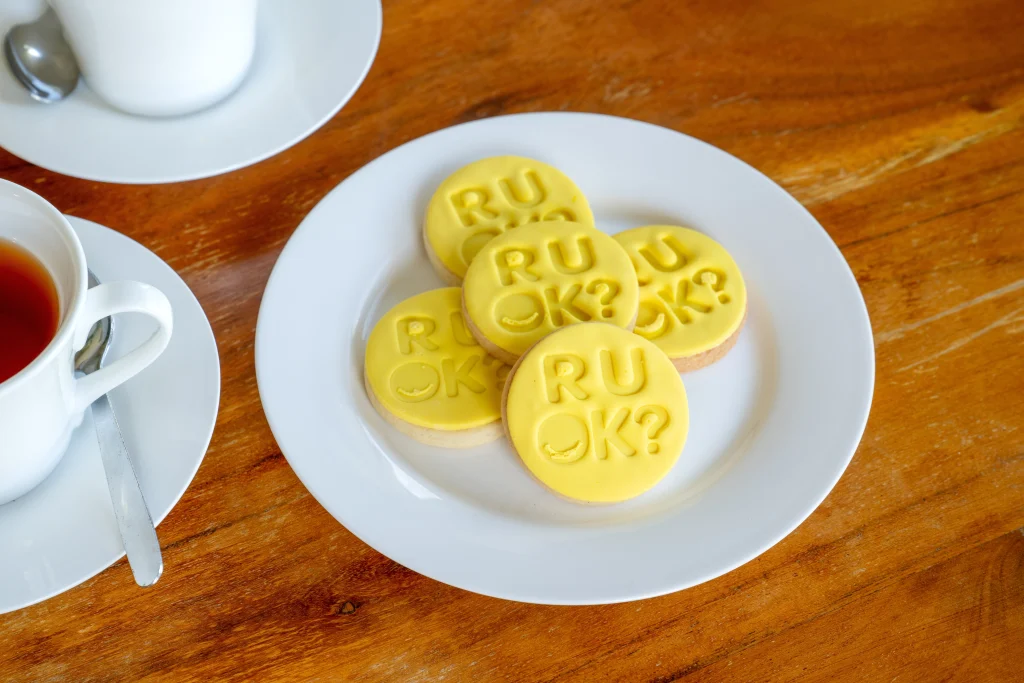
- Host a morning or afternoon tea: put the kettle on, bring out some R U OK Day cupcakes, and give everyone a chance to step away from their usual routine and catch up.
- Wear yellow: encourage everyone to wear something yellow. Keep it simple with an accessory or check out the official R U OK Day shirts and merchandise.
- Create a conversation wall: set up a space for positive R U OK Day messages, conversation starters, or words of encouragement.
- Organise a team lunch: sharing a meal can be a great opportunity to connect with someone you don’t normally get much time to talk to.
- Set up a conversation station: create a comfortable space where people can grab a cuppa, sit down, and chat.
- Run a workplace activity: try conversation bingo, a team challenge, creative workshop, or wellbeing activity.
- Share the message online: use official R U OK Day images and social tiles to encourage others to check in.
- Decorate your space: display an official R U OK Day poster, add yellow decorations, or create a noticeboard with conversation tips.
- Host a fundraiser: morning teas, bake-offs, sausage sizzles, and other events can bring people together while raising funds to support R U OK?
You can also purchase official R U OK Day merchandise, including clothing, wristbands, stickers, and conversation cards. If you plan to use the official R U OK Day logo on your own materials, make sure you check R U OK?’s brand guidelines first.
Whatever you choose to do, keep conversation at the centre of your plans. The yellow decorations and cupcakes might bring everyone together, but taking the time to genuinely connect is what the day is really about.
R U OK Day resources
Not sure where to begin? R U OK? offers plenty of free resources to help Australians organise activities and feel more confident starting meaningful conversations.
There are resources for workplaces, schools, universities and TAFEs, sporting organisations, community groups, and individuals, as well as materials developed for specific communities and industries.
| Resource | How you could use it |
| Conversation guides | Share them with your team, family, or community to help people feel more confident asking R U OK? and responding to the answer. |
| R U OK Day posters | Display them in workplaces, classrooms, break rooms, sporting clubs, or community spaces. |
| Social media resources | Share official R U OK Day images, messages, and digital assets across your social channels. |
| Education resources | Use age-appropriate lesson plans, activities, videos, and presentations in schools and education settings. |
| Videos and presentations | Use them as part of a workplace meeting, school activity, or R U OK Day event. |
| Activity resources | Use printable activities and other materials to get your workplace, school, club, or community involved. |
There are also resources developed for young people, Aboriginal and Torres Strait Islander communities, rural and remote Australians, emergency service workers, tradies, hospitality workers, and more. You can find the full range of official resources through the R U OK? Website!
How to explain R U OK Day to children?
R U OK Day can be a great opportunity to help children learn about kindness, friendship, emotions, and looking out for others.
The way you explain it will naturally depend on their age, but the basic message can be kept simple:
“R U OK Day reminds us to notice when someone might be having a hard time, ask how they’re feeling, listen to them, and get help from a trusted adult when they need it.”
For younger children
Focus on what it means to be a good friend and how they might notice when somebody is feeling sad, worried, angry, lonely, or simply isn’t acting like themselves.
Try asking:
- What can you do if your friend seems sad?
- Who can you talk to when you’re worried?
- What does being a good listener look like?
- What are some kind things you can say to a friend?
- How can you show someone you care?
Make it interactive
Activities can help make these ideas easier for children to understand. They could:
- Create a friendship wall
- Make cards with kind messages
- Draw a picture about what being a good friend means
- Take part in classroom conversation activities

R U OK? also provides Australian education resources for early learning, primary schools, and secondary schools, including:
- Curriculum-aligned lesson plans
- Videos
- Presentations
- Printable activities
- Conversation guides
Remind them they don’t have to solve the problem
Most importantly, children shouldn’t feel responsible for fixing another person’s problems. Instead, teach them to listen, show their friend they care, and tell a trusted adult if they’re worried about someone.
Where to get help
If you or someone you love is struggling, you don’t have to face it alone. There are people who can help, whether you need someone to talk to, practical support, or help finding the right next step. In Australia, you can reach out to services such as Lifeline, Beyond Blue, and Suicide Call Back Service for support. If someone is in immediate danger, call 000 or go to the nearest emergency department. Remember, asking “Are you OK?” can be an important first step, but you don’t have to have all the answers yourself.
R U OK Day FAQs
What colour do you wear for R U OK Day?
Yellow is the colour most commonly associated with R U OK Day.
You could wear a yellow shirt, dress, socks, hat, or even a small yellow accessory. Official R U OK Day shirts and other yellow merchandise are also available through the R U OK? store.
What date is R U OK Day 2026?
R U OK Day 2026 is on Thursday, 10 September 2026.
The National Day of Action is held on the second Thursday of September each year, so the exact date changes from year to year.
What is the key message of R U OK Day?
The key message is that regular, meaningful conversations can help us stay connected and support the people around us through life’s ups and downs.
You don’t need to be a mental health professional to check in. What matters is approaching the conversation with genuine care, listening without judgement, encouraging action when needed, and checking in again afterwards.
What is the theme for R U OK Day 2026?
For 2026, R U OK? is encouraging Australians to “Ask R U OK? Any Day.”
The message reminds us that we don’t need to wait for R U OK Day to check in with someone. According to R U OK?’s 2026 research, one in three people don’t realise the difference they can make by checking in with someone they care about, while nine in 10 people who were asked “Are you OK?” reported feeling grateful, cared about, and supported.
So, while Thursday, 10 September is an important date on the calendar, the conversation doesn’t need to end there.
Whether it’s your best friend, sibling, colleague, neighbour, or someone you haven’t heard from in a while, make checking in a habit throughout the year. Because if someone’s on your mind, you don’t need to wait for the perfect moment to ask how they’re going.